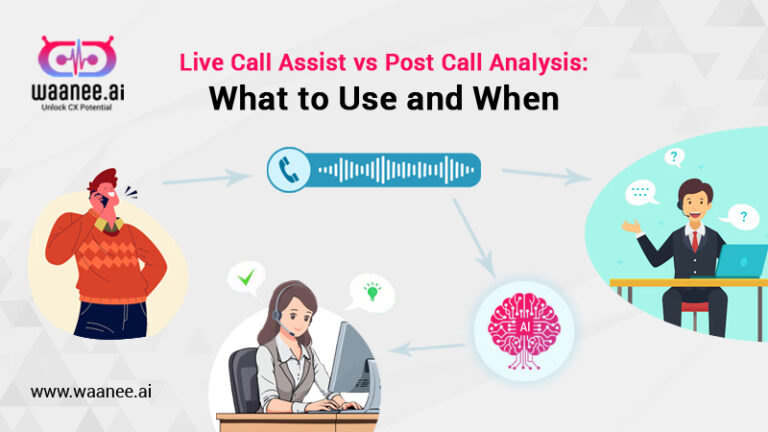
In the pursuit of exceptional customer service, contact centers are constantly seeking ways to empower their agents and refine their strategies. Two powerful approaches have emerged as cornerstones of modern quality assurance: live-call assist and post-call analysis. While both aim to improve performance, they operate at different stages of the customer interaction and serve distinct, yet complementary, purposes.
Understanding the difference in the live-call vs post-call debate is crucial for managers looking to build a comprehensive quality and performance strategy. One provides in-the-moment support, while the other offers a wealth of data for long-term improvement. The key isn’t choosing one over the other, but knowing when to use each to maximize its impact. This guide will break down the roles of real-time agent assist and post-call analytics, helping you decide which tool is right for your specific needs.
What is Live-Call Assist?
Live-call assist, also known as real-time agent assist, is a technology that provides agents with guidance and information during a live customer interaction. It acts as a digital co-pilot, listening to the conversation as it happens and automatically pushing relevant information, script prompts, and next-best-action suggestions directly to the agent’s screen.
The primary goal of real-time agent assist is to improve the outcome of the current call. By equipping agents with the right information at the right time, it helps them resolve issues faster, handle complex queries more accurately, and maintain compliance with company policies.
When to Use Live-Call Assist:
- Onboarding and Training New Agents: New hires often struggle with information overload. A real-time agent assist tool can significantly shorten the learning curve by guiding them through calls, ensuring they follow correct procedures and provide accurate information from day one.
- Reducing Handle Time and Hold Time: When an agent needs to find information, the customer waits. Live-call assist tools can instantly surface knowledge base articles, customer history, or product details, minimizing hold times and leading to quicker resolutions.
- Ensuring Script and Compliance Adherence: For industries with strict regulatory requirements, such as finance or healthcare, real-time agent assist is invaluable. It can prompt agents to read mandatory disclosures and monitor for sensitive information, reducing compliance risk in real-time.
- Improving First-Call Resolution (FCR): By providing immediate access to comprehensive information and step-by-step guidance, agents are better equipped to solve a customer’s problem on the first attempt, boosting FCR rates and customer satisfaction.
What is Post-Call Analysis?
Post-call analysis involves reviewing and analyzing customer interactions after they have concluded. Using call recordings, transcripts, and metadata, this process uncovers trends, identifies agent performance patterns, and provides deep insights into the customer experience. Modern post-call analytics platforms use AI to automatically transcribe and analyze 100% of calls, moving beyond the traditional method of manually sampling a small fraction.
The focus of post-call analysis is on strategic, long-term improvement. It helps managers understand the root causes of issues, identify coaching opportunities, and make data-driven decisions to enhance overall contact center performance.
When to Use Post-Call Analysis:
- Identifying Agent Coaching Opportunities: Post-call analytics can pinpoint specific areas where an agent or a group of agents are struggling. By analyzing trends in call outcomes, script adherence, and customer sentiment, managers can develop targeted coaching programs that address core performance issues.
- Understanding the “Why” Behind Metrics: Your CSAT scores dropped last month, but why? Post-call analytics helps you dive deep into customer conversations to uncover the reasons. You can identify recurring product complaints, confusing processes, or gaps in agent knowledge that are impacting key performance indicators.
- Refining QA Scorecards and Processes: By analyzing thousands of interactions, you can identify the agent behaviors that correlate most strongly with positive outcomes. These insights allow you to build more effective and objective QA scorecards, ensuring you are evaluating what truly matters.
- Informing Business Strategy: The voice of the customer is a goldmine of business intelligence. Post-call analytics reveals what customers are saying about your products, marketing campaigns, and competitors. These insights can inform everything from product development to marketing messaging.
The Power of a Combined Approach
The most effective contact center performance tools don’t force a choice between live-call assist and post-call analytics. Instead, they integrate them into a unified ecosystem. The insights gained from post-call analysis can be used to refine the rules and content that power your real-time agent assist tool.
For example, if post-call analytics reveals that customers are frequently confused about a new billing policy, you can create a real-time prompt that automatically appears for agents whenever keywords related to billing are mentioned. This creates a powerful feedback loop:
- Analyze: Use post-call analytics to identify widespread issues.
- Act: Implement real-time guidance to help agents navigate those issues on live calls.
- Measure: Continue using post-call analysis to measure the impact of the real-time assistance and identify new areas for improvement.
Solutions like Waanee AI recognize that immediate support and long-term strategy are two sides of the same coin. By offering a platform that excels in both real-time guidance and deep-dive analytics, Waanee AI provides a holistic view of your contact center operations. This integrated approach ensures that agents are supported in the moment, while leaders have the data they need to drive continuous, strategic improvement.
Making the Right Choice for Your Center
Ultimately, the live-call vs post-call discussion isn’t about picking a winner. It’s about understanding your primary goals and implementing the right tools to achieve them. If your immediate focus is on reducing handle time and improving FCR, a real-time agent assist tool will deliver a rapid return on investment. If you are focused on long-term strategy, agent development, and understanding the customer journey, post-call analytics is your starting point.
The best strategy, however, is one that doesn’t choose. By leveraging both, you create a resilient, intelligent, and continuously improving contact center that excels at every stage of the customer interaction.
Ready to see how an integrated approach to agent support and analytics can transform your performance? Explore Waanee AI‘s suite of contact center performance tools and discover how we can equip your team for success, both during and after the call.

 Recruit Industries Agents
 Build Your Agent
 Improve Self Service
 Employee Experience
 Sales and Cross Sales
 Calling Script
 Integration & APIs
 Auto Summarization
 Conversational Intelligence
 Sentiment Analytics
 Auto QA
 Net Promoter Score